Silkscreen printing is a method of applying ink to fabric or other flat surfaces by pressing it through a fine mesh screen onto which the design has been transferred as a stencil. Each colour in the design requires a separate screen. The process produces bold, flat, highly durable prints and is the most widely used print method for corporate merchandise in Singapore, covering lanyards, tote bags, aprons, pouches, bandanas, and apparel.
At Printopia, silkscreen printing starts from S$1.50 per piece for lanyards at 200 units and from S$5 per piece for canvas tote bags at 100 units. Screen setup costs S$30 to S$50 per colour and is charged once per design regardless of quantity. Standard lead time is 7 to 12 business days from artwork approval.

What Is Silkscreen Printing?
Silkscreen printing, also called screen printing or silk screen printing, is one of the oldest and most reliable print methods in commercial use. The process works by stretching a fine polyester mesh screen over a frame, then applying a photosensitive emulsion to the screen. The design artwork is used to expose the emulsion to UV light, hardening the areas not covered by the design. The unhardened emulsion is then washed away, leaving the design as an open stencil in the screen.
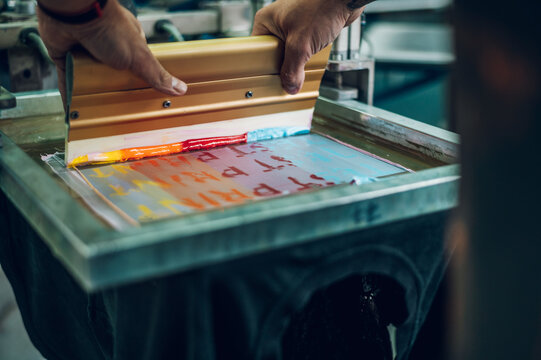
During printing, the item to be printed (a tote bag, apron, lanyard, or pouch) is placed under the screen. Ink is poured across the top of the screen and pulled across with a squeegee, forcing it through the open areas of the stencil and onto the item below. The item is then passed through a heat tunnel or exposed to a heat gun to cure the ink permanently.
For designs with multiple colours, a separate screen is prepared for each colour and each colour is printed in sequence with a drying step between passes. Registration marks ensure the colours align precisely.
The Silkscreen Printing Process Step by Step
- Artwork preparation. The design is separated into individual colour layers. Each colour requires its own screen. Vector artwork (AI or EPS) is the required format for clean separation. Pantone colour references are assigned to each layer.
- Screen preparation. For each colour, a mesh screen is coated with photosensitive emulsion and dried in a dark environment. The colour-separated artwork is output as a positive film and placed on the coated screen.
- Screen exposure. The film-covered screen is exposed to UV light. The emulsion hardens where light passes through the clear areas of the film and stays soft where the design blocks the light.
- Screen washing. The screen is washed with water, removing the soft unhardened emulsion and leaving the design as an open mesh stencil through which ink can pass.
- Printing. The item is placed on the printing press platen. Ink is applied to the screen and a squeegee is drawn across, forcing ink through the stencil openings onto the item below. For multi-colour designs, each colour is printed in sequence.
- Curing. The printed item passes through a conveyor heat tunnel at 160 degrees Celsius, curing the ink and bonding it permanently to the fabric. Properly cured silkscreen prints are wash-resistant and will not crack, peel, or fade under normal use.
- Quality inspection. Each item is checked for colour accuracy, registration, and coverage before being folded, packaged, and dispatched.
What Materials Silkscreen Printing Works On
Silkscreen printing works on any flat, stable surface that can hold ink and withstand the curing heat.
In the corporate merchandise context, it is suitable for:
- Cotton and canvas fabric: tote bags, aprons, pouches, bandanas, t-shirts, caps. The most common substrates for silkscreen in Singapore.
- Polyester and nylon: lanyards, polyester bags, event tabletops. Lower ink absorption than cotton but produces clean, bright prints.
- Non-woven polypropylene (NWPP): trade show and event bags. Very common for high-volume giveaway items.
- Recycled PET (rPET): eco-certified bags and lanyards. Behaves similarly to polyester for silkscreen purposes.
- Jute: natural fibre bags. Silkscreen on jute produces a slightly rougher print edge due to the coarser weave, which some brands find aesthetically appropriate.
Silkscreen is not suitable for curved surfaces (mugs, bottles, pens), items with significant texture variation, or very dark fabrics where ink coverage becomes difficult without expensive specialty inks.
Design Requirements for Silkscreen Printing
Number of colours
Each colour in your design requires a separate screen, a separate printing pass, and a separate setup cost. Designs with one or two colours are the most cost-effective. Three to four colours are common and add moderate cost. Designs with five or more colours become significantly more expensive per unit and are often better handled by heat transfer or dye sublimation.
Gradients, drop shadows, and photographic images cannot be reproduced with standard silkscreen because they require continuous tonal variation. A technique called halftone printing (using tiny dots of varying density) can approximate gradients but adds cost and requires high-quality screens.
Minimum line weight and detail
Fine lines below 0.5mm tend to fill in or break up in silkscreen printing, particularly on textured fabrics like canvas and jute. Very fine serif fonts below 8 point size are also difficult to reproduce cleanly. If your design includes fine detail, discuss it with your supplier before committing to silkscreen as the print method.
Artwork format
Vector artwork in Adobe Illustrator (AI) or EPS format is required for silkscreen. Each colour layer must be clearly separated. Pantone solid colour references must be provided for each colour in the design. A high-resolution PDF with outlined fonts is acceptable as a secondary format. JPEG and PNG files are not suitable for silkscreen preparation because they cannot be colour-separated cleanly.
| Ready to order silkscreen printing in Singapore? Tell Printopia your product, quantity and design. Get a Quote from Printopia → |
Silkscreen Printing Prices in Singapore
Pricing depends on the product, the number of colours, and the quantity ordered.
Here are realistic price ranges from Printopia:
Lanyards
- Polyester lanyard, 1 colour silkscreen (100 pieces): S$1.50 to S$2.50 per piece
- Nylon lanyard, 2 colour silkscreen (100 pieces): S$2.50 to S$4 per piece
- Screen setup: S$30 to S$50 per colour, one-time per design
Tote bags and canvas bags
- Cotton-canvas blend tote, 1 colour silkscreen (100 pieces): S$5 to S$8 per piece
- Canvas tote 260gsm to 320gsm, 1 to 2 colour silkscreen (100 pieces): S$7 to S$13 per piece
- Jute tote, 1 colour silkscreen (100 pieces): S$5 to S$9 per piece
Aprons
- Cotton bib apron, 1 to 2 colour silkscreen (50 pieces): S$10 to S$16 per piece
- Canvas bib apron, 1 to 2 colour silkscreen (100 pieces): S$10 to S$15 per piece
Pouches
- Canvas or cotton pouch, 1 colour silkscreen (100 pieces): S$5 to S$9 per piece
- Jute pouch, 1 colour silkscreen (100 pieces): S$4 to S$7 per piece
Bandanas
- Cotton bandana, 1 to 3 colour silkscreen (100 pieces): S$4 to S$8 per piece
Volume discounts of 25 to 40 percent apply at 300 units and above across all product categories. Screen setup costs become proportionally less significant as quantity increases.
Always request a tiered quote if your order quantity is flexible →
Silkscreen vs Other Print Methods: When to Choose What
Choosing the right print method matters. Here is how silkscreen compares to the alternatives across the criteria that matter most to corporate buyers:
| Method | Visual quality | Colour range | Cost at scale | Durability | Best for |
| Silkscreen | Bold, flat, clean | 1 to 5 solid colours | Lowest at 100+ | Very high | Logos, wordmarks, large runs |
| Embroidery | Premium, textured | Any (thread) | Higher per unit | Highest | Canvas, gifts, uniforms |
| Heat transfer | Good, smooth | Unlimited | Mid range | Good | Complex designs, small batches |
| Dye sublimation | Photographic | Full colour | Mid range | Very high | Polyester, edge-to-edge |
| Reactive dye | Soft, saturated | Full colour | Higher | High | Premium cotton bandanas |
Use silkscreen when: your design has four or fewer solid colours, you are ordering 100 pieces or more, and cost efficiency at scale is a priority.
- Switch to embroidery when you need a premium tactile finish.
- Switch to heat transfer when your design has more colours or gradients than silkscreen can handle.
- Switch to dye sublimation when you need full-colour or edge-to-edge printing on polyester.
Not sure which method suits your design?
Share your artwork with us and we will recommend the best approach →
Live Silkscreen Printing at Events
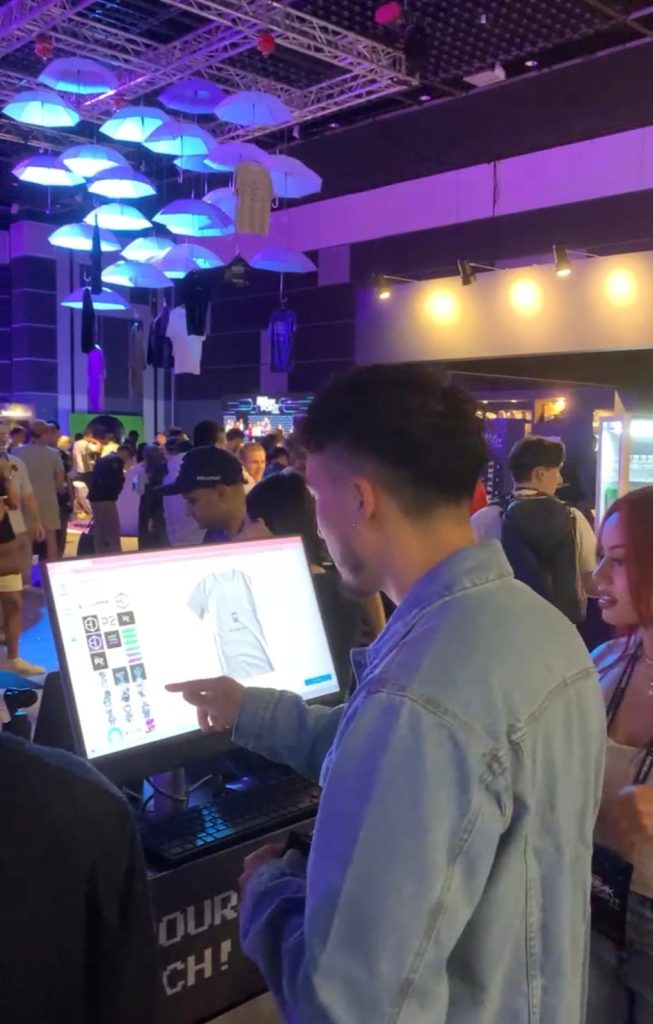
Silkscreen printing can also be performed on-site at corporate events as a brand activation. A portable screen printing rig is set up at your event venue and items (tee shirts, tote bags, aprons, bandanas) are printed in real time in front of attendees. The printing process itself becomes a visual centrepiece that draws crowds and generates social media content.
Live silkscreen is the most visually spectacular of the live printing formats. The physical action of the squeegee pull, the smell of fresh ink, and the immediate reveal of the finished design create a sensory experience that digital brand activations cannot replicate.
For a full guide to live silkscreen printing at Singapore events including setup requirements, throughput, and pricing, see: Live Printing at Events in Singapore →
Products Available with Silkscreen Printing at Printopia
Silkscreen printing is available across the full Printopia merchandise range. Each product below links to its dedicated guide with full material options, pricing, and ordering details.
| Custom lanyards Polyester, nylon, recycled PET and cotton lanyards. Silkscreen from S$1.50 per piece at 100 units. Read more → |
| Custom aprons Cotton and canvas aprons in bib, waist, cross-back, and cobbler styles. Silkscreen from S$10 per piece at 50 units. Read more → |
| Tote bag printing Canvas, cotton, jute, rPET and NWPP tote bags. Silkscreen from S$3 per piece at 200 units. Read more → |
| Custom pouches Canvas, cotton, organic cotton, jute and rPET pouches. Silkscreen from S$4 per piece at 100 units. |
| Custom reusable bags Full range of branded reusable bags. Silkscreen available on all materials. Browse our custom bag options → |
| Live printing at events On-site silkscreen printing for tee shirts, tote bags, aprons and bandanas at corporate events. Learn more about our live printing services → |
Silkscreen Printing at Printopia

Printopia handles silkscreen printing for all product categories in our range.
- In-house screen preparation and printing for all fabric merchandise categories
- Pantone colour matching as standard on every silkscreen order
- Free pre-production digital mockup before any printing begins
- Screen setup at S$30 to S$50 per colour, charged once per design
- MOQ from 50 pieces for most product categories
- Standard lead time of 7 to 12 business days from artwork approval
- Combined orders available across multiple product categories in a single delivery
Frequently Asked Questions
What is silkscreen printing?
Silkscreen printing, also called screen printing or silk screen printing, is a method of applying ink to fabric or other flat surfaces by pressing it through a mesh screen onto which the design has been stencilled. Each colour in the design requires a separate screen and a separate printing pass. The process produces bold, flat, durable prints and is the most widely used print method for corporate merchandise, event giveaways, and branded apparel in Singapore.
How much does silkscreen printing cost in Singapore?
Silkscreen printing in Singapore costs from S$1.50 per piece for lanyards at 100 units, from S$5 per piece for canvas tote bags at 100 units, and from S$10 per piece for cotton aprons at 50 units. Screen setup costs S$30 to S$50 per colour and is charged once per design regardless of quantity. Volume discounts of 25 to 40 percent apply at 300 units and above.
How many colours can silkscreen printing use?
Silkscreen printing can technically reproduce any number of colours, but each colour adds a separate screen and setup cost of S$30 to S$50. Designs with one to four colours are the most cost-effective. Designs with five or more colours are usually better handled by heat transfer or dye sublimation printing, which have no per-colour setup costs.
How long does silkscreen printing take in Singapore?
Standard lead time for silkscreen printing at Printopia is 7 to 12 business days from artwork approval. This includes screen preparation, printing, curing, and quality inspection. Rush orders may be available at a surcharge depending on current production capacity. Add 2 to 3 business days for delivery.
What is the difference between silkscreen and embroidery?
Silkscreen printing applies ink to the surface of the fabric through a stencil, producing a flat printed result. Embroidery stitches the design directly into the fabric using thread, producing a raised, textured result. Silkscreen is more cost-effective at scale, suitable for larger and more detailed designs, and works on a wider range of materials. Embroidery produces a more premium, tactile finish and is significantly more durable for items that are washed frequently. For most event merchandise, silkscreen is the right choice. For uniform programmes and premium gifting, embroidery is usually preferred.
What is silkscreen printing not suitable for?
Silkscreen printing is not suitable for designs with gradients, continuous tone photography, or very fine detail below 0.5mm line weight. It is also not effective on curved or irregular surfaces such as mugs, bottles, or pens. For designs with these characteristics, heat transfer, dye sublimation, or digital printing are more appropriate methods. For curved or rigid items, pad printing is the standard alternative.
Does silkscreen printing last?
Yes. Properly cured silkscreen prints are highly durable and wash-resistant. The ink is cured at approximately 160 degrees Celsius during production, bonding it permanently to the fabric. Under normal washing conditions, silkscreen prints on cotton and canvas will last for years without cracking, peeling, or significant fading. Using the correct ink type for the substrate (plastisol for most fabrics, water-based for lighter applications) and curing to the correct temperature are the two factors that determine longevity.
What artwork do I need to provide for silkscreen printing?
Provide your artwork as a vector file in Adobe Illustrator (AI) or EPS format with each colour on a separate layer. Include Pantone solid colour references for every colour in the design. Fonts must be outlined or embedded. A high-resolution PDF with outlined fonts is acceptable as a secondary format. Do not supply JPEG, PNG, or Word document files as these cannot be colour-separated for screen preparation.
| Ready to order silkscreen printing in Singapore? Contact Printopia with your product, design and quantity for a free quote and mockup. Get a Quote → |