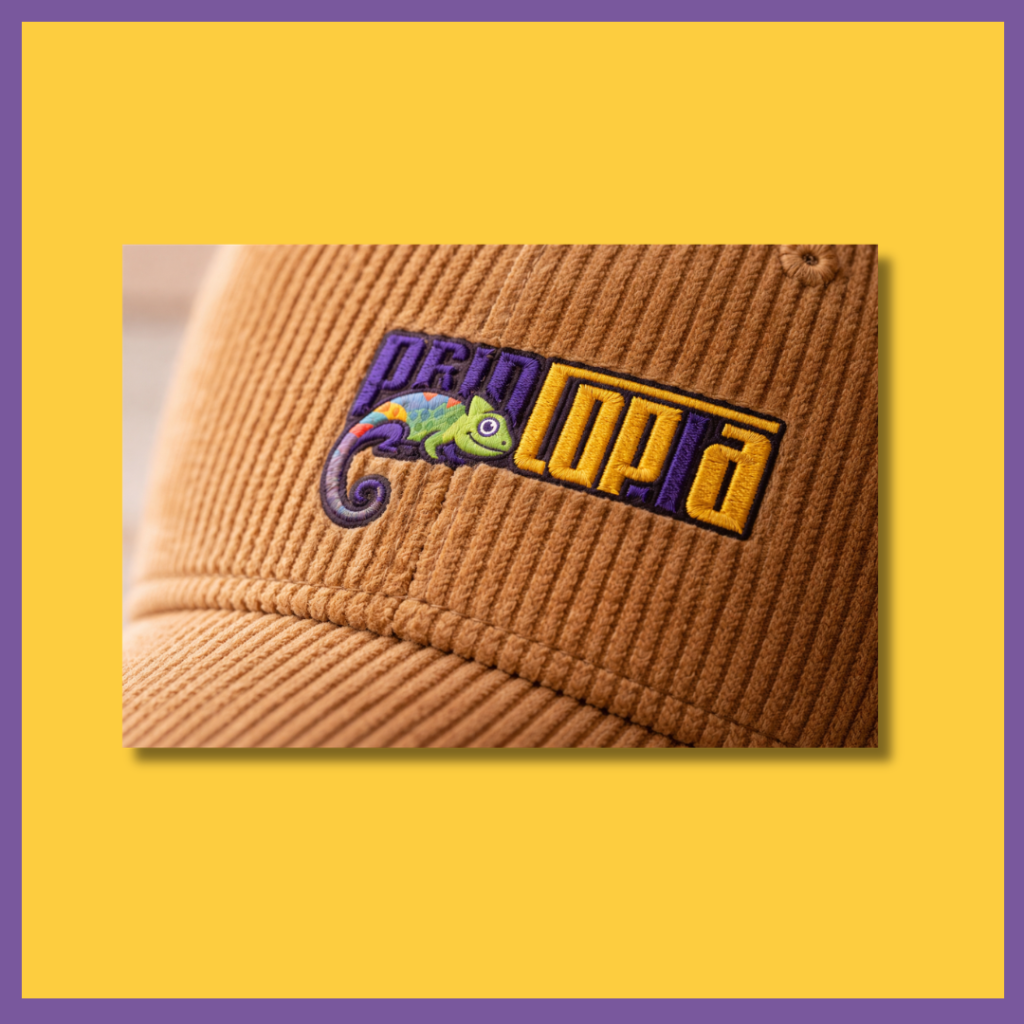
Embroidery is a method of decorating fabric by stitching a design directly into the material using thread. Unlike silkscreen printing, which applies ink to the surface, embroidery creates a raised, textured result that is part of the fabric itself. The result is premium, highly durable, and immediately distinguishable from printed alternatives by touch.
At Printopia, embroidery is available on canvas tote bags, aprons, pouches, and caps. Pricing starts from S$12 per piece for pouches at 100 units and from S$18 per piece for canvas aprons at 50 units. A one-time digitisation fee of S$30 to S$80 applies per design and covers the conversion of your artwork into a machine-readable stitch file. Standard lead time is 12 to 16 business days from artwork approval.

What Is Embroidery?
Embroidery is the craft of decorating fabric using needle and thread. In commercial and corporate merchandise production, machine embroidery is used rather than hand embroidery. An industrial embroidery machine uses multiple needle positions and thread colours to stitch a design automatically, following a digitised file that specifies the exact path, direction, density, and colour of every stitch.
The result is a design that is physically woven into the fabric rather than applied on top of it. An embroidered logo does not sit on the surface of a canvas apron or tote bag. It is in the fabric. This distinction is immediately apparent to anyone who handles the item and is the primary reason embroidery commands a premium over printed alternatives.
Embroidery on fabric corporate merchandise is most commonly used for logos, wordmarks, and simple graphic marks. It is particularly effective on heavy fabrics such as canvas, thick cotton, and nylon where the stitch definition is crisp and the fabric provides a stable base for dense stitching.
The Embroidery Process Step by Step
- Artwork submission. The customer provides the logo or design as a vector file (AI or EPS). Pantone colour references are supplied for each colour in the design. The design is reviewed for embroidery suitability, specifically checking for minimum line weights, text sizes, and detail complexity that may not translate well to stitching.
- Digitising. A specialist digitiser converts the vector artwork into an embroidery stitch file (typically DST or EMB format). This process involves deciding the stitch type for each element (satin stitch for outlines and text, fill stitch for solid areas, running stitch for fine lines), the stitch density, the stitch direction, and the sequence of colour changes. Digitising is a skilled process and the quality of the digitisation determines the quality of the finished embroidery. This is the step covered by the one-time digitisation fee.
- Sample approval. For new designs, a physical sample or a digital stitch simulation is produced for approval before full production. This allows the customer to verify colour matching, sizing, placement, and overall appearance before committing to the full order quantity.
- Hooping. Each item to be embroidered is mounted in a hoop frame that holds the fabric taut and flat during stitching. Proper hooping tension is critical to preventing puckering and distortion in the finished embroidery.
- Machine embroidery. The embroidery machine stitches the design automatically, following the digitised file. Thread colours are changed manually between colour passes. A single logo of average complexity (3 to 5 cm width, 2 to 3 colours) takes approximately 3 to 5 minutes per piece on an industrial machine.
- Trimming and backing removal. Jump threads (thread tails between stitching passes) are trimmed. A backing stabiliser material used during stitching is removed or trimmed flush.
- Quality inspection. Each embroidered item is checked for stitch density, colour accuracy, thread tension, and alignment before being packaged and dispatched.
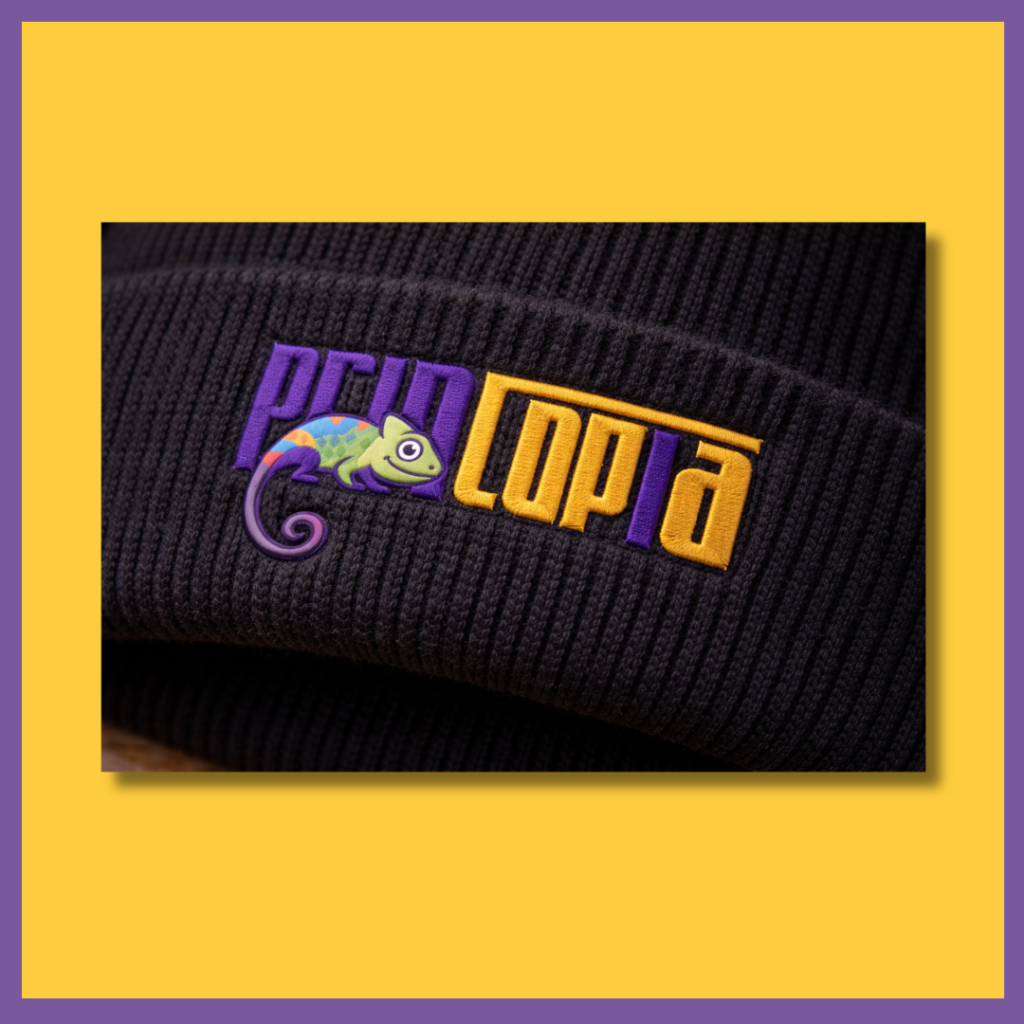
What Materials Embroidery Works On
Embroidery works best on stable, woven fabrics that provide a firm base for stitching.
In the Printopia corporate merchandise range, embroidery is available on:
- Canvas (260gsm to 400gsm): the optimal substrate for embroidery. Heavy canvas provides a stable base, holds stitch definition crisply, and produces the most premium result. Used for tote bags, aprons, and branded carry items.
- Thick cotton (200gsm and above): soft, breathable, and compatible with embroidery at adequate weight. Used for aprons, pouches, and some tote bags. Lighter cotton weights below 180gsm are generally not recommended as the fabric may pucker during stitching.
- Nylon and polyester: suitable for caps and some lanyard hardware accessories. Requires appropriate backing stabiliser to prevent stretch distortion during stitching.
- Denim and drill fabric: commonly used for workwear and F&B uniform aprons. Takes embroidery very well due to the tight weave and stable structure.
Embroidery is generally not suitable for: lightweight cotton below 160gsm, stretchy fabrics (jersey, elastane blends), towelling or terry cloth, and very coarse open-weave materials such as hessian or loose jute. For these substrates, silkscreen, heat transfer, or a woven label are more appropriate.
Not sure which method suits your design?
Share your artwork with us and we will recommend the best approach →
Design Requirements for Embroidery
Minimum text and line size
Text below 5mm cap height is very difficult to reproduce cleanly in embroidery. Satin stitching at this scale collapses and loses legibility. The recommended minimum cap height for readable embroidered text is 6mm to 8mm. Very fine serif fonts with thin strokes are particularly challenging. Sans-serif fonts with uniform stroke widths reproduce more cleanly at small sizes.
Fine lines below 1mm width should be avoided or replaced with a minimum-width running stitch. Designs with very fine detail, photographic elements, or gradients are not suitable for embroidery. Silkscreen or heat transfer are better suited to these design characteristics.
Recommended design dimensions
For a chest logo on a tote bag or apron, a width of 5cm to 10cm produces the best balance of legibility and proportion. Very large embroidered fills (above 15cm x 15cm) become heavy, increase the risk of puckering on lighter fabrics, and take significantly longer to produce per unit. For oversized designs, consider whether silkscreen printing at a larger size would produce a better result.
Number of colours
Most commercial embroidery machines carry 6 to 15 needle positions, meaning that a design can include up to that number of thread colours without a manual thread change. Designs with more than 6 colours add production complexity and cost. Unlike silkscreen, embroidery does not have a per-colour screen setup cost. However, each additional colour adds stitching time per unit and increases the digitising complexity.
Artwork format
Provide your logo as a vector file in AI or EPS format with clearly separated colour layers. Include Pantone solid colour references for every colour so the digitiser can select the closest available thread match. Fonts must be outlined. A high-resolution PDF with outlined fonts is acceptable as a secondary format.
| Interested in embroidery for your next order? Tell Printopia your product, quantity and design. Get a Quote → |
Embroidery Pricing in Singapore
Embroidery pricing has two components: a one-time digitisation fee per design and a per-unit embroidery cost that varies by product and stitch count.
Digitisation fee
S$30 to S$80 per design. Charged once per design regardless of the quantity ordered or the number of times the design is used in future orders. Simple logos with 2 to 3 colours and clean geometry sit at the lower end of this range. Complex logos with fine detail, many colours, or large fill areas sit at the higher end. The digitisation fee is a sunk cost that diminishes in significance as order quantity increases.
Per-unit embroidery cost
- Pouch or small item, simple logo up to 5cm wide (100 pieces): S$12 to S$16 per piece
- Canvas tote bag, logo up to 8cm wide (100 pieces): S$14 to S$20 per piece
- Canvas bib apron, logo up to 8cm wide (50 pieces): S$22 to S$32 per piece
- Cross-back canvas apron, logo up to 8cm wide (50 pieces): S$28 to S$40 per piece
- Cap with structured front panel, logo up to 7cm wide (50 pieces): S$15 to S$22 per piece
Volume discounts of 25 to 40 percent apply at 200 units and above. The per-unit cost of embroidery drops more steeply with volume than silkscreen because there are no per-colour screen costs — the digitisation is already done. An order of 500 embroidered canvas aprons will cost significantly less per piece than an order of 50.
For a direct comparison: a 320gsm canvas tote bag with a 2-colour silkscreen logo at 100 pieces costs approximately S$9 to S$13 per piece. The same bag with embroidery costs S$14 to S$20 per piece at 100 pieces, plus S$30 to S$80 digitisation. The price premium for embroidery is real but narrows substantially at 200 pieces and above.
When to Choose Embroidery Over Other Print Methods
Embroidery is the right choice in the following circumstances:
Uniform programmes with repeated washing
Embroidery is the most wash-durable decorating method available for fabric items. An embroidered logo on a canvas apron used daily in a commercial kitchen and washed multiple times a week will retain its definition and colour for years. Silkscreen prints on frequently washed items will eventually crack and fade, even when properly cured. For any programme where items will be laundered regularly, embroidery is the specification that will hold up.
Premium corporate gifting and high-tier events
When the gift or merchandise item needs to read as genuinely premium, embroidery is the method that achieves it. The texture, weight, and craftsmanship of an embroidered logo communicate a quality level that ink on fabric simply cannot. For VIP client gifts, C-suite relationships, and high-tier D&D door gifts, embroidery is the specification that matches the occasion. See: Premium Corporate Gifts in Singapore [internal link: Post #12].
Brand positioning that values craft and quality
Certain brand identities benefit specifically from embroidery beyond just the premium signal. F&B brands, artisan businesses, luxury retail, and any organisation whose identity is associated with craft and quality will find that embroidery reinforces the brand story in a way that printing cannot. An organic food brand whose aprons have embroidered branding communicates something different from the same apron with silkscreen.
Items with a long expected lifespan
Corporate gifts and merchandise items that will be used and kept for years benefit from embroidery’s superior durability. A canvas tote bag used as a daily carry bag for three years with an intact embroidered logo is a brand impression for three years. The same bag with a cracking silkscreen print after the first year is a negative brand impression. Invest in embroidery for any item intended to last.
When silkscreen is not appropriate
Embroidery is also used by default when silkscreen is not appropriate for the substrate. Very thick canvas, certain denim fabrics, and structured items like caps are better served by embroidery because their surface texture makes silkscreen registration and coverage difficult.
Embroidery vs Other Print Methods
| Method | Look and feel | Detail level | Cost vs silkscreen | Durability | Best for |
| Embroidery | Premium, raised, textured | Good for logos | Higher | Highest | Uniforms, premium gifts |
| Silkscreen | Flat, bold, clean | Good, no gradients | Lowest at 100+ | Very high | Logos, large runs |
| Heat transfer | Smooth, printed feel | Good, full colour | Mid range | Good | Complex designs |
| Dye sublimation | Photographic, soft | Full colour, edge-edge | Mid range | Very high | Polyester items |
Products Available with Embroidery at Printopia
Embroidery is available on the following items in the Printopia range. Each card links to the full product guide.
| Custom aprons Canvas and cotton aprons in bib, waist, cross-back, and cobbler styles. Embroidery from S$22 per piece at 50 units. View our custom apron options → |
| Tote bag printing Canvas and cotton tote bags. Embroidery from S$14 per piece at 100 units. View our custom tote bag options → |
| Custom reusable bags Full range of branded reusable bags. Embroidery available on canvas and thick cotton styles. View our custom bags options → |
| Premium corporate gifts Premium gifting sets where embroidery is the standard specification for the quality tier. View our premium custom corporate gift options → |
Embroidery at Printopia
Printopia handles embroidery in-house for all fabric merchandise categories. Digitisation is done by our in-house team, meaning we have direct control over stitch quality, thread colour matching, and turnaround time. We do not outsource embroidery work to third-party operators.
- In-house digitisation and embroidery for all product categories
- Thread colour matched to Pantone references as closely as available thread stocks allow
- Digital stitch simulation provided before physical production on new designs
- Physical sample available for orders above 100 pieces or for ongoing uniform programmes
- One-time digitisation fee of S$30 to S$80 per design, credited against future repeat orders on some programmes
- MOQ from 30 pieces for most embroidery applications
- Standard lead time of 12 to 16 business days from artwork approval
- Combined orders: embroidered items can be ordered alongside silkscreen-printed items (lanyards, bandanas) in a single combined order with consistent Pantone colour references across all items
Frequently Asked Questions
What is embroidery printing?
Embroidery is the decoration of fabric by stitching a design into the material using thread, guided by an industrial embroidery machine following a digitised stitch file. Unlike silkscreen or heat transfer printing, which apply ink or film to the fabric surface, embroidery creates a raised, textured result that is physically part of the fabric. It is the most premium and durable decorating method available for fabric corporate merchandise.
How much does embroidery cost in Singapore?
Embroidery in Singapore has two cost components. The digitisation fee is S$30 to S$80 per design, charged once regardless of quantity. The per-unit embroidery cost ranges from S$12 to S$16 per piece for pouches at 100 units, S$14 to S$20 for canvas tote bags at 100 units, and S$22 to S$40 for aprons at 50 units depending on style. Volume discounts of 25 to 40 percent apply at 200 units and above.
What is embroidery digitising and why is it needed?
Embroidery digitising is the process of converting a logo or artwork file into a machine-readable stitch file that tells the embroidery machine exactly how to reproduce the design in thread. The file specifies the stitch type, stitch direction, stitch density, thread colour sequence, and the order in which elements are stitched. A poorly digitised file produces poor embroidery regardless of machine quality. The digitisation fee covers this specialist conversion process and is charged once per design.
How long does embroidery take in Singapore?
Standard lead time for embroidery at Printopia is 12 to 16 business days from artwork approval. This includes the digitisation step for new designs, sample approval if required, production, and quality inspection. Add 2 to 3 business days for delivery. For ongoing uniform programmes using previously digitised designs, lead time is typically 10 to 14 business days.
What is the difference between embroidery and silkscreen printing?
Silkscreen printing applies ink to the surface of the fabric, producing a flat printed result. Embroidery stitches the design into the fabric using thread, producing a raised, three-dimensional, textured result. Embroidery is more expensive per unit and has a higher minimum order cost due to digitisation. It is significantly more durable, particularly for items washed frequently, and produces a noticeably more premium appearance and feel. Silkscreen is the right choice for large runs, event merchandise, and cost-sensitive applications. Embroidery is the right choice for uniform programmes, premium gifting, and items intended to last for years.
Can any design be embroidered?
Not all designs translate well to embroidery. Designs with very fine detail below 1mm line weight, photographic elements, gradients, or very small text below 5mm cap height are difficult or impossible to reproduce cleanly in stitching. Logos and wordmarks with clean lines, solid shapes, and limited colour are the best candidates for embroidery. If your design has characteristics that may be problematic, Printopia can advise during the digitising stage whether modifications are needed or whether a different print method would produce better results.
Is the digitisation fee charged for every order?
No. The digitisation fee is charged once per design for the initial order. The stitch file is retained by Printopia and used for all subsequent orders of the same design without an additional digitisation charge. Modifications to the design that require re-digitisation (significant changes to size, colour layout, or design elements) will incur a new fee. Minor adjustments such as size scaling within a defined range are typically made without additional cost.
What is the minimum order for embroidery in Singapore?
Printopia’s minimum order quantity for embroidery is 30 pieces for most product categories. Some categories with higher setup complexity may require 50 pieces as a minimum. Contact us to discuss your specific requirements if your order is below these thresholds.
| Ready to order embroidery in Singapore? Contact Printopia with your product, quantity and design for a free quote. Get a Quote → |