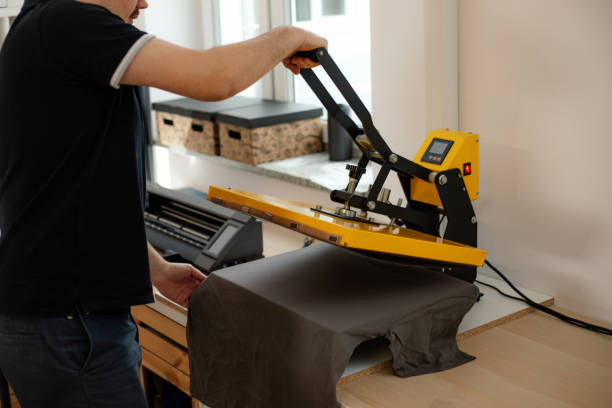
Heat transfer printing is a method of applying a design to fabric by printing the artwork onto a special transfer film and then pressing it onto the item using a heated press. The heat and pressure cause the ink or vinyl to bond permanently to the fabric surface. The process supports full colour, gradients, and fine detail that silkscreen printing cannot achieve, and requires no per-colour screen setup costs, making it cost-effective for small batches and complex designs.
At Printopia, heat transfer printing is available on aprons, tote bags, lanyards, pouches, and apparel. Pricing starts from S$6 per piece for lanyards at 100 units and from S$9 per piece for canvas tote bags at 100 units. There is no screen setup cost. Standard lead time is 7 to 12 business days from artwork approval.
What Is Heat Transfer Printing?
Heat transfer printing uses a heated press to permanently bond a pre-printed design to a fabric surface.
The process begins with printing the artwork onto a carrier film using either inkjet or laser printing technology. The printed transfer film is then placed face-down on the fabric item and passed under a heat press at a specified temperature (typically 150 to 180 degrees Celsius) and pressure for a set dwell time (usually 10 to 20 seconds). The heat causes the ink or adhesive to release from the carrier and bond to the fabric fibres. The carrier film is then peeled away, leaving the design adhered to the fabric.
There are several heat transfer variants used in commercial merchandise production. Standard cut-and-weed vinyl heat transfer uses coloured vinyl cut into the design shape. Digital inkjet heat transfer prints a full-colour image onto a transparent film. Plastisol heat transfer prints a thick ink layer onto a release paper. Each variant has different characteristics in terms of colour range, texture, washability, and suitable substrates.
In the context of Singapore corporate merchandise, digital inkjet heat transfer is the most commonly used variant because it supports unlimited colours and photographic detail without setup costs per colour.
The Heat Transfer Printing Process Step by Step
- Artwork preparation. The design is prepared as a high-resolution digital file. Unlike silkscreen, colour separation is not required. Full-colour artwork including gradients, photographs, and detailed illustrations can be reproduced directly. The file is checked for resolution (minimum 300dpi at print size) and colour accuracy.
- Transfer film printing. The artwork is printed onto a specialised heat transfer film using an inkjet or laser printing system. The printed film is then cut to the required shape. For digital transfers, a white base layer is often printed first to ensure colour accuracy on coloured or dark fabrics.
- Pre-pressing. The fabric item is placed on the heat press platen and a brief pre-press pass removes moisture and wrinkles, ensuring a flat, stable surface for the transfer.
- Transfer application. The printed film is placed face-down on the item at the correct position. The heat press closes at the specified temperature and pressure for the required dwell time. Heat and pressure activate the adhesive, bonding the ink to the fabric.
- Peeling. After pressing, the carrier film is peeled away either hot or cold depending on the transfer type. Hot peel transfers are removed immediately while the item is still warm. Cold peel transfers are allowed to cool completely before the carrier is removed. Cold peel generally produces a sharper edge definition.
- Curing and quality check. The finished item is inspected for adhesion quality, colour accuracy, and edge definition. Any items with lifting edges, air bubbles, or colour inconsistency are removed from the batch.
What Materials Heat Transfer Printing Works On
Heat transfer printing works on a wide range of fabric substrates. In the Printopia corporate merchandise range, it is compatible with:
- Cotton and cotton-canvas blends: tote bags, aprons, pouches, bandanas. Cotton accepts heat transfer well at standard temperatures. The most common substrate for heat transfer in the corporate merchandise context.
- Polyester and poly-cotton blends: lanyards, polyester bags, event merchandise. Works well but requires temperature adjustment to avoid scorching synthetic fibres. Dye sublimation is often the preferred alternative for full-polyester items.
- Nylon: lanyards and accessories. Compatible with heat transfer at appropriate temperatures and dwell times.
- Non-woven polypropylene: event bags. Heat transfer works but the lower melting point of NWPP requires careful temperature management.
Heat transfer is generally not recommended for: very open-weave materials (loose jute, hessian), heavily textured fabrics where the transfer cannot achieve full surface contact, leather or leather-look materials, and waterproof-coated fabrics where the coating prevents adhesion.
Design Requirements for Heat Transfer Printing
Colour range and complexity
Heat transfer’s primary advantage over silkscreen is its unrestricted colour range. Full-colour photographs, gradients, drop shadows, and complex illustrations can all be reproduced accurately without additional setup costs. This makes it the go-to method for designs that cannot be simplified to four or fewer solid colours.
Resolution
Artwork must be provided at a minimum resolution of 300 dots per inch (dpi) at the intended print size. A file that is 300dpi at a 5cm width is not suitable for printing at 10cm width as scaling up halves the effective resolution. For best results, provide artwork at 600dpi at print size or as a vector file that can be rasterised at any resolution.
White base layer
On dark-coloured fabrics, a white base layer is printed beneath the artwork before the colour layers to ensure accurate colour reproduction. Without a white base, colours appear washed out or transparent against a dark substrate. If your design includes light colours, pastels, or white elements to be printed on a dark bag or apron, confirm with your supplier that a white base is being used in the transfer preparation.
Edge definition
Heat transfer prints have a defined edge where the transfer film ends. On some transfer types, this edge is slightly visible as a smooth border around the design. For designs that include background fills extending to the edge of the transfer area, this border is not noticeable. For designs with isolated elements on a transparent background (a logo floating on fabric with no background fill), the transfer edge may be visible on close inspection. Discuss transfer type selection with your supplier to minimise this effect.
File format
High-resolution raster files (TIFF, PNG with transparency, or high-resolution JPEG) at 300dpi minimum are the primary file format for heat transfer. Vector files (AI or EPS) are accepted and preferred where available as they can be output at any resolution. Pantone colour references are useful for brand-critical colours but heat transfer colour matching is calibrated to digital colour profiles (RGB or CMYK) rather than Pantone ink mixing.
| Need heat transfer printing in Singapore for a complex design or small batch? Tell Printopia your product, quantity and artwork. Get a Quote → |
Heat Transfer Printing Prices in Singapore
Heat transfer pricing has no per-colour setup cost. The price per unit covers the transfer film production and pressing time. Pricing varies by product and design complexity:
- Lanyard, heat transfer (100 pieces): S$6 to S$9 per piece
- Canvas or cotton tote bag, heat transfer (100 pieces): S$9 to S$14 per piece
- Cotton apron, heat transfer (50 pieces): S$12 to S$20 per piece
- Canvas pouch, heat transfer (100 pieces): S$7 to S$11 per piece
- Small batch (20 to 50 pieces), any fabric item: add approximately 20 to 30 percent to the above ranges
Heat transfer is typically 10 to 30 percent more expensive per unit than silkscreen at equivalent quantities, but has no screen setup cost. This makes it more cost-effective than silkscreen for small batches (under 50 pieces) or for designs with many colours where silkscreen setup costs would add significantly to the total order cost.
At 100 pieces and above with a simple design, silkscreen is usually the better value option.
When to Choose Heat Transfer Over Other Print Methods
Complex or multi-colour designs
If your design has more than four solid colours, includes gradients, drop shadows, or photographic elements, heat transfer is the right choice. Silkscreen cannot reproduce these characteristics without halftone techniques that add cost and limit quality. Heat transfer reproduces them without any additional setup.
Small batches
For orders under 50 pieces, heat transfer is often more cost-effective than silkscreen because it avoids the S$30 to S$50 per-colour screen setup cost that makes small silkscreen runs expensive. A 20-piece order of aprons with a 3-colour design is almost always cheaper via heat transfer than silkscreen when total cost including setup is calculated.
Fast turnaround on urgent orders
Heat transfer has no screen preparation step, which can save 1 to 3 business days compared to silkscreen on urgent orders. If you have a hard deadline and the design cannot be simplified for silkscreen, heat transfer is the fastest route to a quality result.
Photographic or gradient artwork
Brand activation items, product launch merchandise, and event memorabilia sometimes incorporate photographic or highly detailed artwork that reflects the specific campaign rather than just the company logo. Heat transfer is the appropriate method for these applications.
When silkscreen is not available on the substrate
Some fabric items in the Printopia range are better suited to heat transfer than silkscreen due to their construction or texture. Confirm with your supplier which methods are available for your specific item before briefing the design.
Heat Transfer vs Other Print Methods
| Criteria | Heat transfer | Silkscreen | Embroidery | Dye sublimation |
| Colour range | Unlimited | 1 to 5 solid | Any (thread) | Unlimited |
| Gradients | Yes | No | No | Yes |
| Setup cost | None | Per colour | Digitisation | None |
| Best batch size | 20 to 150 | 100 and above | 30 and above | 50 and above |
| Durability | Good | Very high | Highest | Very high |
| Substrate | Most fabrics | Most flat fabrics | Stable wovens | Polyester only |
Products Available with Heat Transfer Printing at Printopia
Heat transfer printing is available across the following items in the Printopia range:
| Custom lanyards Polyester and nylon lanyards. Heat transfer from S$6 per piece at 100 units. Suitable for multi-colour designs on standard lanyard widths. View our custom lanyard options → |
| Custom aprons Cotton and canvas aprons. Heat transfer from S$12 per piece at 50 units. Recommended for complex or full-colour logo designs. View our custom aprons options → |
| Tote bag printing Canvas and cotton tote bags. Heat transfer from S$9 per piece at 100 units. No colour setup cost for multi-colour designs. View our custom tote bag options → |
Heat Transfer Printing at Printopia
Printopia handles heat transfer printing in-house alongside silkscreen and embroidery. Having all three methods available under one roof means we can recommend the right method for your specific design and quantity rather than defaulting to a single method regardless of suitability.
- In-house heat transfer printing for all fabric merchandise categories
- No per-colour setup cost on any heat transfer order
- Full-colour and photographic designs reproduced accurately
- Free digital mockup showing colour and placement before production
- MOQ from 20 pieces for most heat transfer applications
- Standard lead time of 7 to 12 business days from artwork approval
- Combined orders: heat transfer items can be combined with silkscreen-printed or embroidered items in a single order
Frequently Asked Questions
What is heat transfer printing?
Heat transfer printing is a method of applying a design to fabric by printing the artwork onto a special transfer film and bonding it to the item using a heated press. The heat and pressure cause the ink to permanently adhere to the fabric surface. It supports full colour, gradients, and fine detail without any per-colour setup costs, making it suitable for complex designs and small batches.
How much does heat transfer printing cost in Singapore?
Heat transfer printing in Singapore costs from S$6 per piece for lanyards at 100 units, S$9 to S$14 per piece for canvas tote bags at 100 units, and S$12 to S$20 per piece for aprons at 50 units. There is no per-colour screen setup cost. For small batches under 50 pieces, add approximately 20 to 30 percent to the per-unit price. Heat transfer is typically 10 to 30 percent more expensive per unit than silkscreen at equivalent quantities but avoids silkscreen’s per-colour setup cost.
What is the difference between heat transfer printing and silkscreen printing?
Silkscreen printing applies ink directly through a stencilled mesh screen onto the fabric, producing a flat, opaque, very durable result. It is the most cost-effective method for large runs of simple 1 to 4 colour designs but requires a setup cost of S$30 to S$50 per colour and cannot reproduce gradients. Heat transfer printing bonds a pre-printed film to the fabric using heat and pressure. It supports unlimited colours, gradients, and fine detail with no setup cost per colour but is slightly more expensive per unit at scale and has a different surface feel (slightly smoother than silkscreen).
Is heat transfer printing durable?
Heat transfer prints are durable under normal use and washing conditions. A properly applied heat transfer will last for years with regular machine washing at standard temperatures (30 to 40 degrees Celsius). Washing at high temperatures above 60 degrees, tumble drying on high heat, or using harsh detergents can reduce longevity. Heat transfer durability is generally slightly lower than silkscreen for heavily washed items. For items laundered multiple times a week such as F&B uniforms, silkscreen or embroidery are the more durable specifications.
What file format do I need for heat transfer printing?
High-resolution raster files at minimum 300dpi at print size are the primary format for heat transfer. PNG files with a transparent background are preferred for designs that will float on the fabric without a background fill. TIFF files are also acceptable. Vector files (AI or EPS) are ideal where available as they can be rendered at any resolution. Provide Pantone or RGB colour references for brand-critical colours. JPEG files are acceptable only if the resolution is sufficient and there are no transparency requirements.
Can heat transfer printing be used on dark fabrics?
Yes. Heat transfer printing on dark fabrics requires a white base layer to be printed beneath the design artwork. Without a white base, colours become transparent and wash out against the dark substrate. Most professional heat transfer suppliers include a white base as standard for dark fabric applications. Confirm this with your supplier when briefing an order for dark-coloured bags, aprons, or other items.
What is the minimum order for heat transfer printing in Singapore?
Printopia’s minimum order quantity for heat transfer printing is 20 pieces for most product categories. This lower minimum compared to silkscreen (which typically starts at 50 pieces) is one of the practical advantages of heat transfer for small events, sampling runs, or pilot gifting programmes. Contact us to discuss requirements below 20 pieces.
How does heat transfer printing compare to dye sublimation?
Both methods support full colour and unlimited design complexity. The key difference is the substrate requirement. Dye sublimation requires a white or light-coloured polyester fabric base and infuses the ink into the polyester fibres, producing a softer hand feel and permanent colour. Heat transfer works on a wider range of substrates including cotton and canvas but bonds a film layer to the fabric surface rather than infusing into it. For polyester items, dye sublimation generally produces a better result. For cotton and canvas items, heat transfer is the appropriate full-colour method.
| Ready to order heat transfer printing in Singapore? Contact Printopia with your product, design and quantity for a free quote. Get a Quote → |