
Need an urgent custom corporate gifting quote?
WhatsApp us →
DTG printing stands for direct-to-garment printing.
It uses a modified inkjet printer to apply water-based ink directly onto the fabric surface of a garment, in the same way a desktop printer applies ink to paper. The result is a full-colour, photographic-quality print with soft hand feel, no setup cost per colour, and the ability to print single items or very small batches economically.
At Printopia, DTG printing is used for t-shirt and apparel printing, and as one of the three methods available for live printing activations at Singapore events.
It is the only print method in the Printopia range that supports true per-garment personalisation at an event — printing a different name, number, or design on each item without additional setup. Pricing starts from approximately S$8 to S$15 per garment for standard t-shirt prints at small quantities.
What Is DTG Printing?
Direct-to-garment (DTG) printing is a digital printing process that uses specialised inkjet technology to print designs directly onto fabric. The garment is loaded onto a flat platen (similar to a printer bed) and the print head passes over the fabric depositing water-based ink in precise droplets to build up the design. The process is entirely digital: no screens, no film, no setup steps between one design and the next.
DTG was developed as a practical solution to the main limitations of traditional garment printing methods. Silkscreen printing requires a separate screen per colour and is cost-effective only at quantities above 50 to 100 pieces. Embroidery cannot reproduce photographic detail or complex illustrations. Heat transfer supports full colour but leaves a film layer on the fabric. DTG eliminates all three constraints: it supports unlimited colours, produces photographic quality, has no surface film, and can print one garment as economically as one hundred.
The trade-off for DTG is throughput. A DTG printer produces 15 to 25 garments per hour under normal operating conditions. At scale above 200 to 300 pieces with the same design, silkscreen typically becomes more cost-effective. DTG is the right choice for small batches, complex artwork, and personalised items — not for high-volume runs of the same design.
How DTG Printing Works: Step by Step
- Pre-treatment.
- For dark-coloured garments, a pre-treatment liquid is applied to the fabric surface and heat-pressed to dry. Pre-treatment opens the fabric fibres to receive the ink and provides the white base layer that allows accurate colour reproduction on dark substrates. Light-coloured and white garments typically do not require pre-treatment.
- Garment loading.
- The garment is stretched flat onto the printer platen and secured to eliminate creases and folds. Even minor wrinkles in the loaded garment will cause the print head to print over uneven surfaces, resulting in lines or gaps in the finished print. Correct loading is the most skill-dependent step in the DTG process.
- White base layer (dark garments only).
- For dark-coloured garments, a white ink layer is printed first to create an opaque base for the colour inks. This is what allows bright, accurate colours to appear on a black or navy garment — without the white base, the design colours would be absorbed into the dark fabric and become muted or invisible.
- Colour printing.
- The design is printed in full colour by the print head passing over the garment in multiple passes. Water-based CMYK inks are layered to build up the final colours. The entire print process for a standard t-shirt design takes 3 to 8 minutes depending on the design size and complexity.
- Heat curing.
- The printed garment passes under a heat press or conveyor heat tunnel to cure the water-based inks. Curing bonds the ink permanently to the fabric fibres. Without proper curing, DTG prints will wash out. Correct curing temperature and dwell time are critical to wash durability.
- Quality inspection.
- The finished garment is inspected for colour accuracy, coverage completeness, and print registration before being folded or packaged.
What Fabrics DTG Printing Works On
DTG printing has specific substrate requirements that are important to understand before specifying it for an order or event activation.
100 percent cotton: optimal
DTG ink is water-based and is specifically formulated to bond with natural cellulose fibres. 100 percent cotton is the optimal substrate. Ring-spun cotton at 140gsm to 200gsm is the standard specification for DTG t-shirts. The ink penetrates the cotton fibres during curing and produces vivid, wash-resistant colour with a soft hand feel. Pre-treatment is required for dark cotton garments.
Cotton-rich blends (above 50 percent cotton)
Cotton-polyester blends above 50 percent cotton produce acceptable DTG results. The cotton component of each fibre accepts the ink while the polyester component does not. On blends, the result is slightly less vibrant than on 100 percent cotton because the ink density per fibre is lower. Blends at 65 percent cotton or above produce results that are generally acceptable for most applications. Below 50 percent cotton the results become increasingly variable.
Polyester and synthetic fabrics: not suitable
DTG ink does not bond to polyester or other synthetic fibres. On a 100 percent polyester garment, DTG ink sits on the surface rather than being absorbed and will wash out almost entirely after one or two washes. For full-colour printing on polyester garments, dye sublimation is the correct method.
See: Dye Sublimation Printing Singapore →
Dark vs light garments
DTG works on both light and dark garments, but with different process requirements and cost implications. Light garments (white, cream, light grey, pastels) print directly without pre-treatment and at the fastest throughput. Dark garments (black, navy, dark grey, deep colours) require a pre-treatment step and a white base layer, which adds time per garment and slightly higher ink cost. For bulk orders of dark garments, this adds approximately S$1 to S$3 per garment to the cost relative to light garment equivalents.
| Interested in DTG printing for t-shirts or live event activations in Singapore? Tell Printopia your quantity, design and garment colour. Get a Quote → |
DTG vs Other Print Methods: When to Choose DTG
The right method depends on the specific application. Here is when DTG wins over the alternatives:
DTG vs silkscreen printing
Silkscreen is more cost-effective for runs of 50 pieces and above with the same design. It also produces more vibrant, opaque colours on some fabrics due to the higher ink deposit. DTG is better when: the design has more than four colours or includes gradients and photographs, the quantity is under 50 pieces, or each item needs a different personalised element. For identical design runs above 50 pieces on cotton garments, silkscreen is usually the better value.
For small batches and complex artwork, DTG wins.
See: Silkscreen Printing Singapore →
DTG vs heat transfer
Both methods support full colour with no per-colour setup cost. The key difference is the substrate and the surface feel. DTG requires cotton or cotton-rich fabric and produces a soft, ink-in-fabric result. Heat transfer works on a wider range of substrates including polyester and mixed materials, but leaves a film layer on the surface. For cotton garments where hand feel matters, DTG produces the superior result. For non-cotton garments or very small batches where speed is the priority, heat transfer is more practical.
See: Heat Transfer Printing Singapore →
DTG vs embroidery
Embroidery produces a tactile, premium result that DTG cannot replicate. For corporate polo tees, aprons, and branded workwear where a professional stitched logo is the specification, embroidery is the right choice. DTG is the right choice when the design is a large-format illustration, photograph, or complex artwork that cannot be rendered in stitching. The two methods serve different design categories and are rarely direct competitors.
DTG for live event personalisation
DTG’s most distinctive advantage is its ability to print a different design on each garment without any setup change. At live event printing activations, this means each attendee can receive a personalised item — their name, their team’s number, or a unique design variation — without slowing throughput or adding setup cost per variation. Silkscreen and heat transfer cannot achieve true per-garment personalisation without significant additional setup. This makes DTG the only practical live printing method for personalised on-demand production.
See: Live Printing at Events in Singapore →
DTG Printing for T-Shirts in Singapore
T-shirt printing is the primary application for DTG in Singapore’s corporate and events market. DTG is used across several t-shirt categories at Printopia:
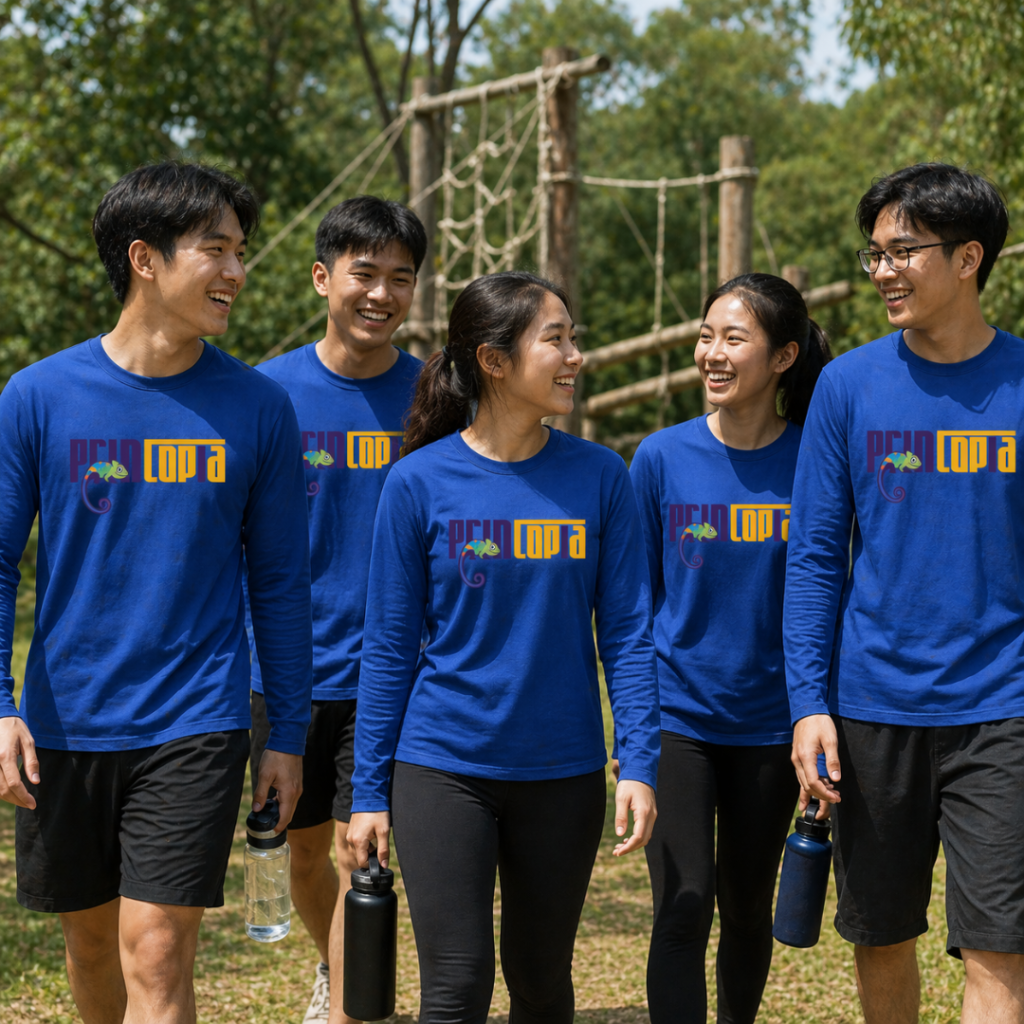
- Class t-shirts: student cohorts and school groups often want unique individual designs or names on matching t-shirts — a requirement that silkscreen cannot fulfil economically. DTG prints each shirt individually from a single digital file with no additional setup cost per variation.
- CCA and sports team t-shirts: player numbers, names, and positions on a consistent design. DTG allows the full personalised set to be printed from a single order.
- Corporate campaign t-shirts: complex illustrative or photographic campaign artwork that exceeds silkscreen’s colour and detail capabilities.
- Small-batch event t-shirts: runs under 30 pieces where silkscreen screen setup costs would make the order uneconomical.
- Live printing activations: on-site printing at product launches, brand activations, and corporate D&Ds where the printing process is part of the event experience.
For the full t-shirt printing guide covering all methods and applications,
see: T-Shirt Printing Singapore →
Pricing Guide for DTG Printing in Singapore
DTG pricing per garment at Printopia is based on the garment type, garment colour (light vs dark), and print size. Unlike silkscreen, there is no per-colour setup cost — the price is per item.
- White or light-coloured cotton t-shirt, standard front print (1 to 30 pieces): S$8 to S$15 per piece
- Dark-coloured cotton t-shirt, standard front print (1 to 30 pieces): S$12 to S$20 per piece (includes pre-treatment and white base)
- Larger or full-front prints: add S$2 to S$5 per piece depending on design coverage area
- Live event DTG printing: pricing includes equipment setup and operator — contact Printopia for event-specific quotation
DTG becomes less cost-effective than silkscreen at quantities above approximately 50 pieces for light garments and 30 pieces for dark garments when the design stays the same across all items. For personalised orders where each garment has a different name or number, DTG remains the practical choice regardless of quantity because silkscreen cannot achieve the same result.
For context: a class of 40 students each wanting their name and class number on a matching t-shirt design is a DTG order by necessity — silkscreen would require 40 separate screens. A company ordering 200 identical branded t-shirts for an event is a silkscreen order.
What to Prepare for a DTG Printing Order
- Garment specification: colour (light or dark), fabric content (must be 100 percent cotton or cotton-rich blend), and size breakdown if multiple sizes are required.
- Artwork file: high-resolution raster file at minimum 300dpi at print size (PNG with transparent background preferred for designs without a background fill). Vector files (AI or EPS) are also accepted and can be output at any resolution.
- Colour mode: RGB for digital files. DTG output is calibrated to digital colour profiles.
- Print size and placement: specify width and height of the print area in centimetres and the placement on the garment (front centre, back, sleeve).
- Personalisation data: for orders with variable personalisation (names, numbers), provide the full list of personalisation details in a spreadsheet with the corresponding garment size for each.
- Quantity and delivery date.
DTG Printing at Printopia
Printopia operates DTG printing in-house for t-shirts, apparel, and live event activations. DTG is one of six print methods available at Printopia alongside silkscreen, embroidery, heat transfer, dye sublimation, and reactive dye.
- Full-colour capability: photographs, illustrations, gradients, and complex designs reproduced accurately
- Personalisation: each garment in an order can carry different text, numbers, or design elements
- Light and dark garments: both supported with appropriate pre-treatment for dark substrates
- Standard lead time: 5 to 10 business days from artwork approval for small to medium batches
- Live event DTG: available as part of Printopia’s live printing activation service for Singapore events
Frequently Asked Questions
What is DTG printing?
DTG stands for direct-to-garment printing. It uses a specialised inkjet printer to apply water-based ink directly onto the fabric surface of a garment. The process supports unlimited colours, photographic detail, and gradients with no setup cost per colour or per design. It works best on 100 percent cotton or cotton-rich garments. DTG is used for t-shirt printing, complex apparel designs, personalised items, and live event printing activations.
What is the difference between DTG and silkscreen printing?
Silkscreen printing applies ink through a stencilled mesh screen, requiring a separate screen per colour and a minimum quantity to be cost-effective (typically 50 to 100 pieces). It produces more vibrant, opaque results on some fabrics and is significantly cheaper per unit at high volumes. DTG uses an inkjet printer with no screen setup, supports unlimited colours, can print single items, and allows each garment to be different. For identical runs of 50 or more pieces, silkscreen is usually more cost-effective. For small batches, complex designs, or personalised items, DTG is the practical choice.
What fabrics can be DTG printed?
DTG printing works best on 100 percent cotton. Cotton-polyester blends above 50 percent cotton produce acceptable results. DTG does not work on 100 percent polyester or other synthetic fabrics — for polyester garments, dye sublimation is the appropriate full-colour method. Both light and dark garments can be DTG printed; dark garments require a pre-treatment step and a white ink base layer.
How much does DTG printing cost in Singapore?
DTG printing at Printopia costs approximately S$8 to S$15 per piece for light-coloured cotton t-shirts at small quantities (1 to 30 pieces) and S$12 to S$20 per piece for dark-coloured garments. Larger or full-front print areas add S$2 to S$5 per piece. There is no per-colour or per-design setup cost. At quantities above 50 pieces with the same design, silkscreen typically becomes more cost-effective.
How long does DTG printing take in Singapore?
Standard lead time for DTG printing at Printopia is 5 to 10 business days from artwork approval for small to medium batches. For personalised orders with variable data (names, numbers), allow an additional 1 to 2 business days for data processing. Add 2 to 3 business days for delivery. For live event DTG activations, setup is completed on-site before the event opens.
Can DTG printing be used for personalised items?
Yes. This is one of DTG’s most significant advantages over other print methods. Each garment in a DTG order can have a different name, number, or design variation without any additional setup cost or time per variation. The digital file is updated between garments with no physical setup change. For class t-shirts, sports team jerseys, event personalisation, and any programme where individual customisation is required, DTG is the only cost-effective print method available.
What is the difference between DTG and heat transfer printing?
Both methods support full colour with no per-colour setup cost. DTG applies ink directly into the cotton fabric surface during printing and curing, producing a soft hand feel with no visible film layer. Heat transfer applies a pre-printed film to the garment surface using heat and pressure, leaving a slight film layer on the fabric. DTG requires cotton or cotton-rich fabric. Heat transfer works on a wider range of substrates including polyester and mixed materials. For cotton garments, DTG produces a superior hand feel. For non-cotton garments or very fast turnaround small batches, heat transfer is more practical.
Is DTG available for live printing at Singapore events?
Yes. Printopia offers DTG as one of three live printing methods for Singapore event activations alongside silkscreen and heat transfer. DTG is the live printing method of choice when personalisation is the headline feature — each attendee can receive a garment with their name, a unique design element, or variable data printed on the spot. Throughput is 15 to 25 garments per hour, making it suitable for smaller crowds or premium activations where the personalised result justifies longer per-item production time. For full details on live printing activations, see: Live Printing at Events in Singapore →
| Ready to order DTG printing in Singapore? Contact Printopia with your garment specification, design, and quantity for a free quote. Get a Quote → |